How chess experts see the board differently — and what that means for how you should train.
The Hidden Architecture of Chess Thinking
"Tactics is knowing what to do when you have something to do; strategy is knowing what to do when you don't have anything to do"
— Savielly Tartakover
When players sit down at a chessboard, they don't all "see" the same thing. In chess, patterns refer to the visual layout of the board - the raw, surface-level ability to register how pieces are arranged. This allows a player to notice that a bishop is diagonally aligned with a king, or that pawns form a chain. But patterns have a deeper layer too: perception linked with stored internal meaning. An expert doesn't just see a diagonal of pieces - they recognise it as a potential pin or long-range threat. Built over years of exposure to typical positions, these patterns allow experts to rapidly interpret what a configuration implies for the game's future. Perception provides the visual organisation; knowledge abstracts the sense - transforming scattered visual details into a coherent, strategic picture.
What is a pattern in chess, and how is it developed?
Perception plays a central role in how players interpret and navigate the board, shaping the difference between novice and expert performance. Rather than seeing 64 separate squares and 32 pieces, experienced players develop chunks - meaningful configurations such as familiar openings, tactical motifs, or strategic structures. An analogy with reading makes the process clear:
At the beginning, a reader learns to recognise individual letters, such as "t" and "h". With practice, these letters form chunks, such as "th", and later "the" (Gobet et al., 2001).
These chunks reduce cognitive load and enable faster, more accurate decision-making, since the player is not evaluating each piece in isolation but perceiving relationships and dynamics across the board. This pattern-based perception explains why strong players can recall complex positions after only a glance, while beginners struggle to reconstruct even simple arrangements.
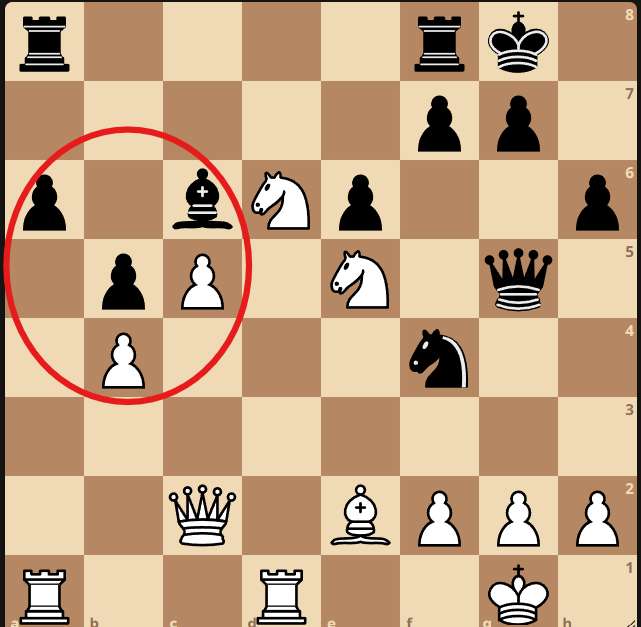
Figure 1. Perceptual chunk X
For example, a cluster of pawns and pieces in the corner is not just a random arrangement to an experienced player - it is a recognisable pawn structure with pressure points that signal strategic tension on the queenside.
Players develop perceptual patterns gradually through experience and repeated exposure. Beginners start by seeing only individual pieces and their moves. Over time, they begin recognising recurring formations - pawn chains, open files, tactical motifs - because these appear again and again across different games. With practice, the brain chunks these recurring structures into single units of meaning, reducing the need for step-by-step calculation. Chunks are also compositional: over time they evolve into larger, more complex structures, incorporating more objects and additional information such as verbal labels (Gobet et al., 2001).
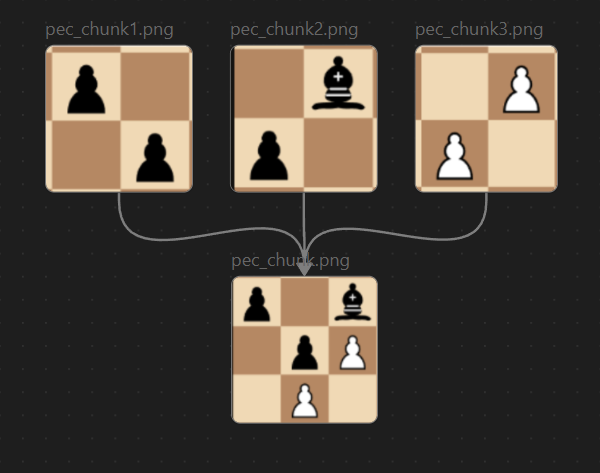
Figure 2. Chunk Composite
These patterns enable players to process complex positions more efficiently, recalling typical formations and anticipating plans without analysing each square individually. Chess expertise relies less on raw calculation and more on the ability to see the board in organised patterns - turning complexity into manageable, recognisable structures. This process is reinforced by studying classic games, solving tactical puzzles, and playing regularly, all of which strengthen memory for common configurations.
Generalization
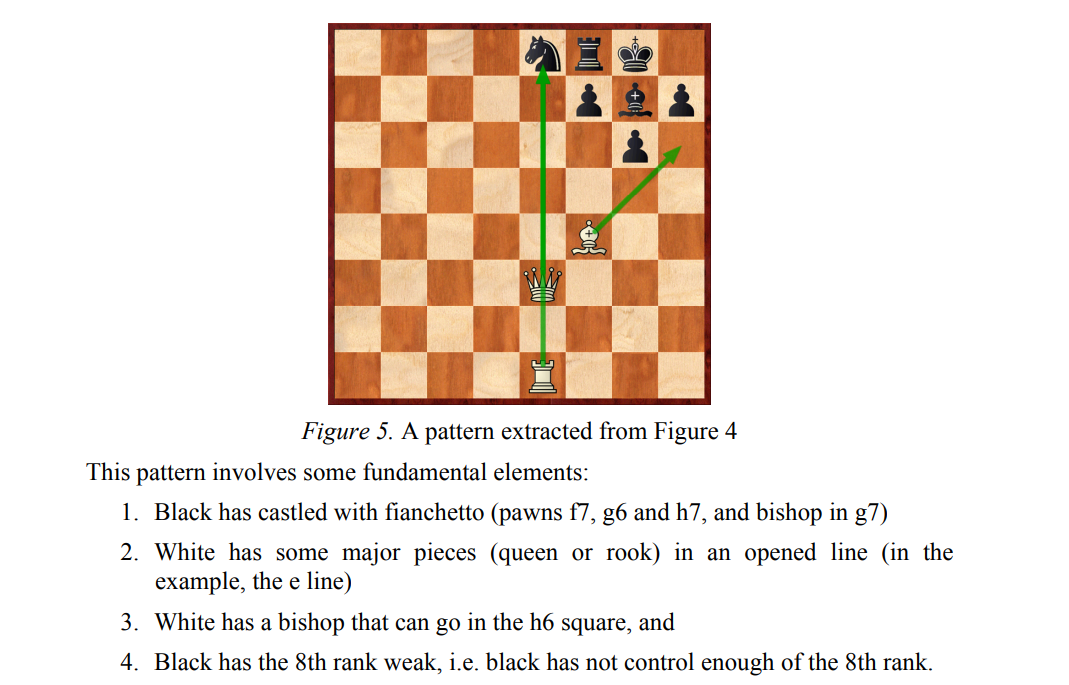
The perceptual part of a chunk forms the first layer of understanding - what a player immediately sees on the board. These visual cues are essential, but by themselves they don't capture the deeper meaning of a position. That meaning comes from configural concepts: mental constructs, introduced by Ferro (2012), that arise when players interpret not just individual pieces, but the relationships between them within the whole position - similar to Gobet's template theory. A configural concept is made up of chess objects and their conceptual relationships, and its meaning emerges from the hierarchical linkage of those relationships and from each object's position within the board's broader theoretical structure.
"The" now it is not just a recurring arrangement of letters t h e but a relation between individual pieces held together, used particularly as a definite article.
For example, noticing that a pawn is isolated is perceptual. Understanding its strategic implications - whether it creates weakness or dynamic potential - requires interpreting the relationships between that pawn and surrounding pieces. Experts move fluidly between these levels: perception allows them to notice key features quickly, while configural concepts help them judge significance, anticipate consequences, and integrate observations into broader plans.
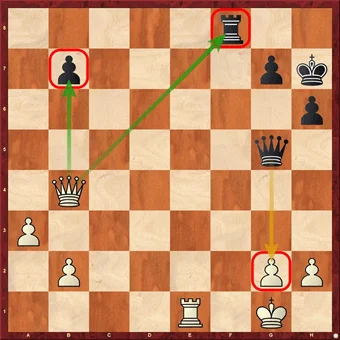
Figure 3. Relations among chess pieces
The power of configural concepts lies in their capacity for generalisation - the ability to draw on past experience and apply it flexibly to new situations. D'Ereditá and Ferro argue that expert play is not about memorising specific positions, but about recognising patterns that combine geometry (how pieces are placed) with logic (how play is likely to unfold). Consider the fork motif: a player who has encountered a knight fork doesn't merely remember that specific position - they abstract a general concept: one piece attacking two or more enemy pieces simultaneously. This abstraction can be recognised and applied across countless different board configurations.
"One piece attacking two or more enemy pieces simultaneously" - capture relation among objects, but also abstracts away specificity and makes a general principle or a rule
This rule can be labelled and applied to many different instances. Once labelled-such as the tactical motif fork in chess-it functions as a reusable pattern that can be recognized across positions.
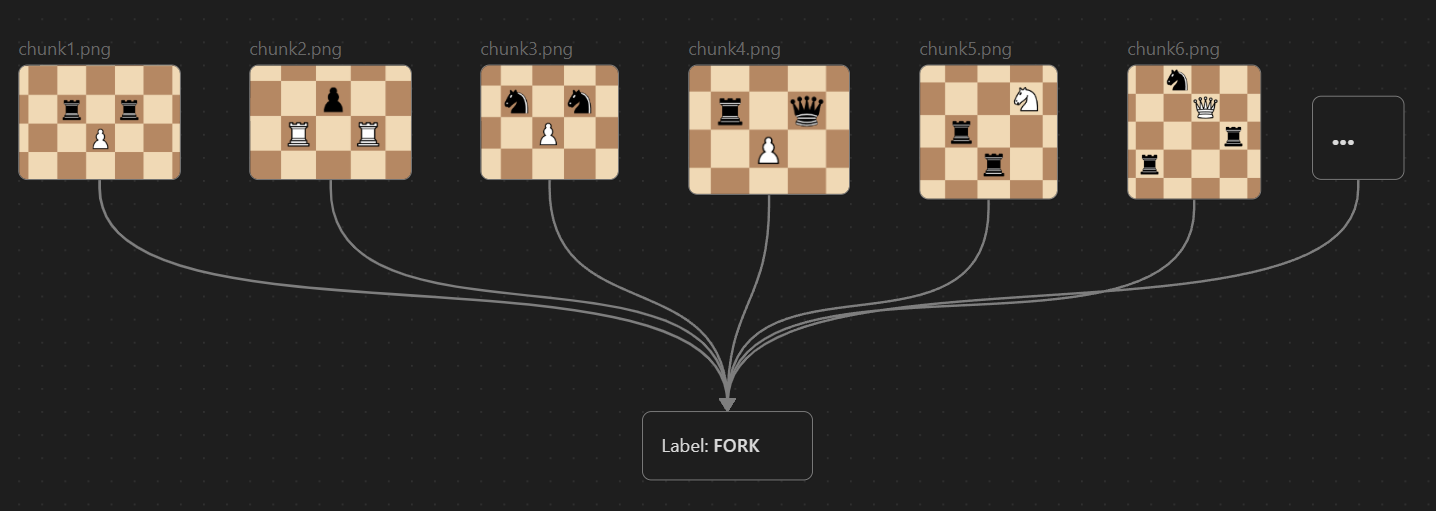
Figure 4. Generalisation of Chunks
This generalisation operates through a structured hierarchy of types and subtypes. A type represents the broadest level - any piece attacking two or more undefended pieces simultaneously. A subtype narrows this down: for example, a pawn forking two or more undefended pieces. The subtype inherits the core logic but adds a constraint, making it a more specific version of the same underlying pattern. Positions that are visually distinct may still be perceived as equivalent by an experienced player, because what matters is not surface appearance but the internal structure of the configural concept.
Example from linguistics: There is "love", and its subtypes such as "mothers' love", "friends' love", etc.
This recognition develops gradually: a player first learns a pattern in one specific area of the board, then begins identifying the same abstract structure in different quadrants, on different colours, in different directions, and with different piece types (Barsalou & Bower, 1984; Lane & Gobet, 2012; Muggleton et al., 2010). Generalisation, in this sense, is the progressive detachment of a pattern from its original context - until its underlying logic can be recognised anywhere on the board.
Once individual chunks are generalised and labelled, they can be combined into larger, more complex structures. A player doesn't just recognise a weak square in isolation - they tie it together with an open file, a poorly placed enemy piece, and a strategic plan into a single, unified picture of the position. Each concept builds on the last, forming a web of interconnected ideas that captures not just what is happening on the board, but what should happen next.
"Love recognizes no barriers." - now abstract concepts can be tied together into a wider picture, and so on into a complex idea.
These hierarchical patterns are also tied directly to action. Chunks can be linked to a move, a sequence of moves, a strategic idea, or a tactical motif. A chunk encoding a pawn structure with a weak square might trigger the instruction: place a knight on this square - a condition-action pair known in psychology and AI as a production. The pattern is not merely recognised; it is understood in terms of what it demands. Seeing a weak square does not prompt calculation from scratch - it triggers a ready-made response. Perception, conceptual structure, and decision-making are woven into a single, fluid process.
This suggests that chess expertise is built from layered components, each depending on the one before it:
- Perceptual recognition - noticing raw visual arrangements of pieces on the board
- Chunking - grouping those arrangements into meaningful units that reduce cognitive load
- Generalization - abstracting the underlying logic of a chunk so it can be recognized across different positions, colors, and piece types
- Typology - organizing generalized patterns into hierarchies of types and subtypes, from broad principles down to specific variations
- Template formation - combining multiple generalized chunks into larger, richer structures that capture whole strategic or tactical landscapes
- Production - linking recognised patterns directly to action, so that seeing a familiar structure automatically triggers the appropriate move or plan, as a condition-action pair
This framework is more than theory - it is a blueprint for deliberate improvement. Each layer points directly to a training method: building perceptual recognition through puzzle repetition, strengthening chunks by replaying classic games, deepening generalization by studying the same motif across many different positions, and expanding templates by analyzing complete games and structures.
Progress, in other words, is not random. A player who trains with this hierarchy in mind is not just practicing chess - they are systematically building the perceptual architecture that expert play runs on.
References
D'Ereditá, G.; Ferro, F. (2015). Generalization in chess thinking. PNA, 9(3), 245-259.
Ferro, M. (2012). Chess thinking and configural concepts. Acta Didactica Universitatis Comenianae, 15-30. X
Gobet, F., Lane, P., Croker, S., Cheng, P., Jones, G., Oliver, I., & Pine, J. (2001). Chunking mechanisms in human learning. Trends in Cognitive Sciences, 5, 236-243.
Like this kind of deep analysis?
Get one data-driven chess insight per week — long-form essays on training, psychology, and Elo growth.