Chess expertise is not a matter of thinking deeper or harder, but of seeing more.
Why Chess Players Make Mistakes — And What It Reveals About the Expert Mind
“Experts see chunks where novices see isolated pieces.”
— Herbert A. Simon
Every chess player knows the feeling: you calculate a line, it seems to hold, you play it — and somewhere in the sequence something quietly breaks. The blunder wasn't random. It wasn't carelessness. And yet there it is. Understanding why this happens turns out to reveal something fundamental about how chess expertise is structured — and where, almost by necessity, it breaks down.
A 2021 study by psychologist Marko Antolčić examined exactly this question, by placing players of different strengths in front of deliberately manipulated positions and measuring the consequences. The results are worth thinking about carefully.
The Experiment: Find the Winning Move — With a Few Tricks Thrown In
Antolčić's study used a classic chess puzzle format: mate in two. No long-term planning, no complex strategy — just a single, sharp challenge. Can you spot the move that forces checkmate in exactly two steps?
Forty-eight club players took part, ranging from solid amateurs to near-expert level. Each person solved 24 puzzles. But here's the twist: the puzzles weren't presented the way they'd normally look.
Every position came in four different "flavors," created by tweaking two things. First, the pieces that had nothing to do with the solution could be arranged in a natural, game-like way — or shuffled into patterns you'd rarely see in a real game. Second, a single extra piece might be planted near the opponent's king: menacing, dangerous-looking, seemingly ready to deliver checkmate — except it couldn't do so in two moves, only three. These two tricks were designed to throw solvers off in different ways. And as it turned out, they worked very differently indeed.
Perceptual Distraction: When the Board Stops Making Sense
Chess positions have an internal grammar. Pieces cluster by color, by function, by proximity to the critical action. Experienced players have internalized this grammar so deeply that a familiar structure — a castled king behind a pawn chain, a rook bearing down an open file — registers not as a collection of individual pieces but as a single meaningful unit. Researchers call these units chunks, and a grandmaster-level player carries an estimated 300,000 of them in long-term memory.
This chunking is what allows strong players to reconstruct a complex position after only a few seconds of exposure. They are not memorizing locations; they are recognizing structures, the same way a fluent reader processes words rather than letters.
When background pieces were randomized — scattered into arrangements that violate the spatial logic of real chess — that recognition process stalled. Players took significantly longer to solve the same mating patterns. Accuracy dropped. And crucially, the background pieces had no functional relationship to the solution whatsoever. They could not interfere with the mate. They were simply wrong-looking, and that alone was enough to slow everything down.
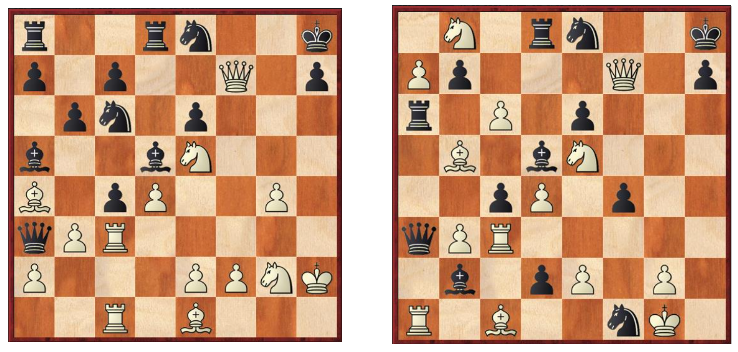
Figure 1. The same mating pattern presented with a natural and a distorted background - perceptual distraction
This finding aligns with a well-established body of research: scrambled positions strip away the perceptual advantage that separates experts from novices, because that advantage is built on structure recognition, not raw calculation. Remove the structure, and the expert must calculate from scratch — exactly like everyone else.
Functional Distraction: When the Board Suggests the Wrong Answer
The second manipulation was more subtle, and considerably more damaging to accuracy. A single piece was added to the position — a bishop, knight, or rook — placed near the opponent's king, with functional connections to the surrounding pieces. This piece was not part of the correct mating sequence in two moves. But it participated in a mating sequence in three. It was a genuine threat — just not the right one.
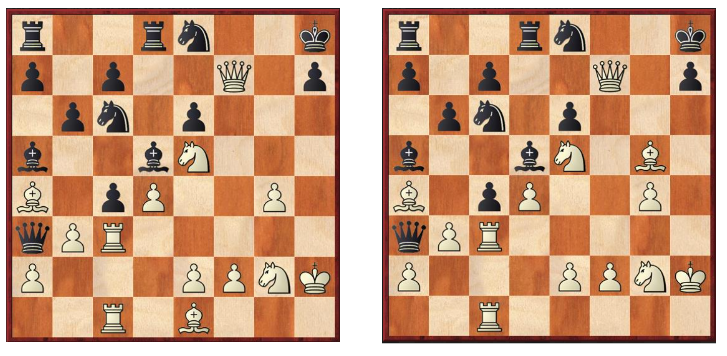
Figure 2. The same mating pattern presented without and with a functional distractor (Bishop on g5) - functional distraction
Where perceptual distraction cost players time, functional distraction cost them correctness. Error analysis revealed that in a significant proportion of incorrect attempts, players did not simply fail to find the solution — they actively chose the distractor's move, apparently convinced they had found the winning line. The added piece had activated a familiar pattern: a threatening piece near the king, functional connections to the position, the shape of a combination. The brain recognized something that resembled a solution, and the search effectively stopped.
What seems to be happening is a kind of mental lock-in. When a player spots the distractor piece — threatening, well-placed, looking every bit like the key to checkmate — it triggers a ready-made pattern from memory that races ahead of the alternatives and wins. Attention then rallies around it, scanning the board for confirmation rather than truth.
But here's the telling detail: that pattern couldn't actually deliver checkmate. The distractor needed three moves, not two. The solution was structurally unavailable — and yet players committed to it anyway, unaware that the door they were pushing on was locked from the inside.
This is functional fixedness at the level of mental representation. The activated pattern didn't just compete with the correct one — it crowded it out, narrowing the search space before the right answer ever had a chance to surface. This connects directly to the Einstellung effect: once a familiar schema takes hold, attention flows toward whatever confirms it and away from whatever doesn't. The search becomes self-sealing — players weren't failing to think hard enough, they were thinking hard in exactly the wrong direction.
What makes this finding particularly significant is that it held across both skill groups. Stronger players were more accurate overall, but the functional distractor reduced accuracy for both groups in roughly equal proportion. Expertise did not confer immunity to the trap — it conferred a somewhat greater ability to escape it.
The Fundamental Tension in Chess Expertise
These results point to something worth sitting with: the cognitive architecture that makes a strong player strong is the same architecture that makes them vulnerable to a specific class of error.
Pattern recognition is not passive storage. It is an active system that directs attention, generates candidate moves, and shapes the interpretation of a position — automatically, rapidly, and largely below conscious awareness. When the right pattern fires, the player moves quickly and correctly. When the wrong pattern fires, it pulls attention toward the wrong features of the position and makes the correct features harder to perceive.
Functional distraction exploits this directly. It introduces a piece whose semantic properties — its activity, its proximity to the king, its functional relationships — trigger a pattern that resembles a winning idea. The recognition system does exactly what it is designed to do. The problem is that it is responding to the wrong signal.
This is not a correctable flaw. It is an inherent consequence of how expertise is built. A system fast enough and automatic enough to be genuinely useful will occasionally fire on incomplete information. The same speed that makes strong players strong is what occasionally makes them wrong — in a way that slower, more deliberate calculation rarely would.
Understanding this opens a practical question: can players be trained to genuinely reconsider competing solution representations — not just check their chosen move, but stay truly open to an alternative pattern winning out? That is where the research leads next.
Further Reading
- Antolčić, M. (2021). The influence of perceptual and functional background distraction on the process of solving tactical chess problems. University of Zadar.
- Bilalić, M., McLeod, P., & Gobet, F. (2008). Why good thoughts block better ones: The mechanism of the pernicious Einstellung effect. Cognition, 108(3), 652–661.
- Chase, W. & Simon, H. (1973). Perception in chess. Cognitive Psychology, 4(1), 55–81.
- Gobet, F. & Simon, H. (1996). Templates in chess memory: A mechanism for recalling several boards. Cognitive Psychology, 31, 1–40.
- Saariluoma, P. & Kalakoski, V. (1998). Apperception and imagery in blindfold chess. Memory, 6, 67–90.
Like this kind of deep analysis?
Get one data-driven chess insight per week — long-form essays on training, psychology, and Elo growth.